简体中文
简体中文 English
 繁体中文
繁体中文 Deutsch
What precautions should be taken when using YSA servo tapping power head for deep hole drilling
Published:
2026-08-20
This article introduces possible issues in process selection and other aspects when using YSA servo tapping power head for deep hole drilling, and provides detailed answers to the precautions for this type of machining.
Many CNC machining professionals have experienced this: when drilling deep holes, even though the equipment parameters remain unchanged, drill bit life suddenly shortens, and issues like tool breakage or oversized hole diameters may even occur. Especially when using the YSA servo tapping head for combined drilling and tapping operations, deep hole chip evacuation and rigidity retention become the biggest challenges.
Today, we will discuss several key technical points that must be noted when drilling deep holes with a high-precision servo power head, based on the actual working conditions of the YSA BD03 series servo spindle.
Why is deep hole machining prone to problems?
The core difficulty of deep hole machining (typically holes with a depth-to-diameter ratio greater than 5) lies in "chip evacuation" and "heat dissipation." As the drill bit penetrates deeper into the workpiece, cutting fluid struggles to reach the cutting edge, and chips cannot be discharged smoothly. For a high-speed, high-precision servo power head like the YSA, although its dual-servo structure provides stable torque output, improper process parameters can amplify even minor vibrations, leading to abnormal tool wear.
Five key considerations for drilling deep holes with the YSA servo power head
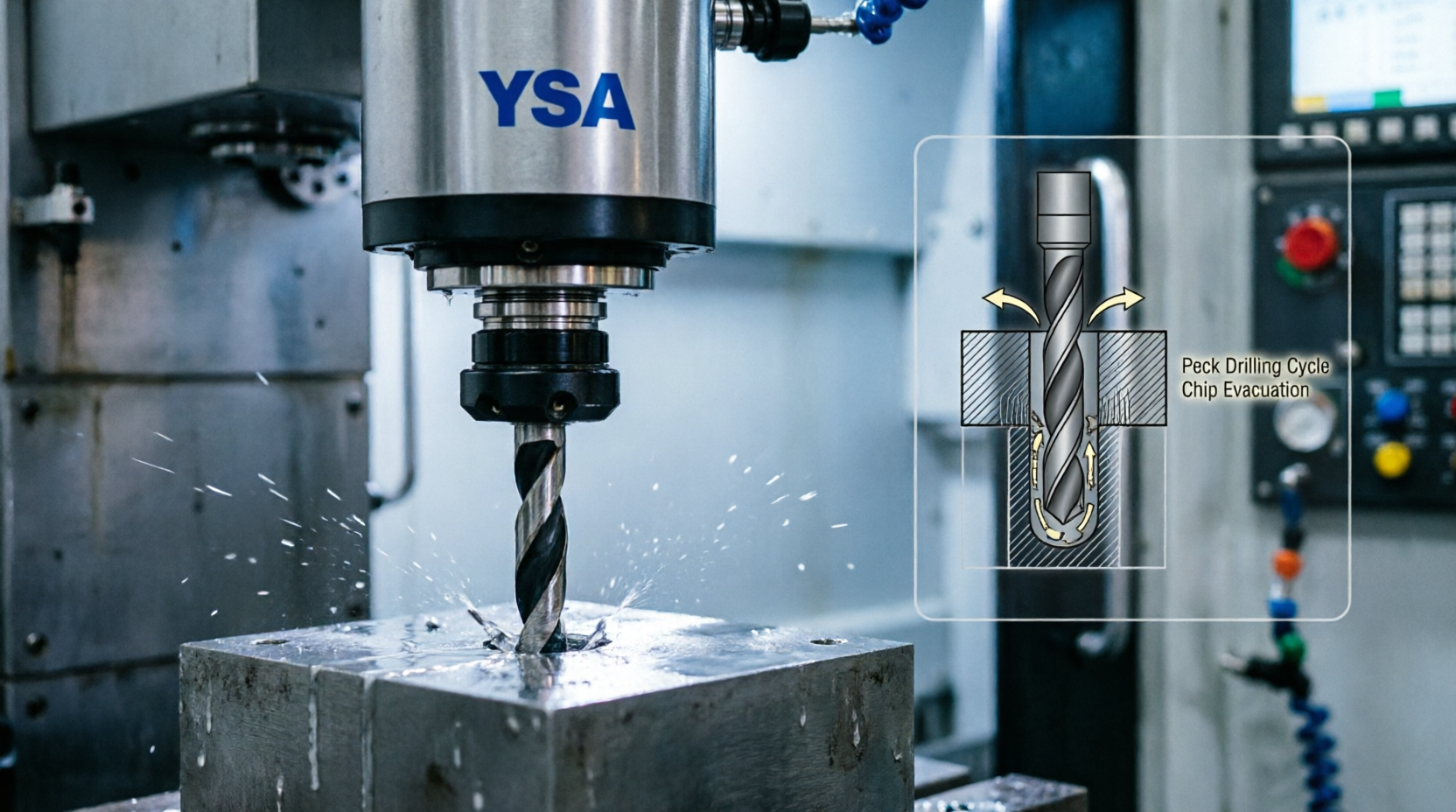
1. Properly select peck drilling cycle parameters
Do not attempt to drill "all the way through in one pass." When programming with the YSA control system, be sure to enable the peck drilling function.
Recommendation: Keep each feed depth within 1-2 times the hole diameter, and ensure the retraction distance is sufficient to allow chips to be completely evacuated from the hole. The high-response characteristics of the YSA servo spindle maintain positional accuracy even during frequent acceleration and deceleration, an advantage that traditional pneumatic heads cannot match.
2. Ensure the internal coolant system is unobstructed
For deep hole machining, external cooling is almost ineffective. It is essential to use a drill bit with through-spindle coolant capability and utilize the internal coolant channels of the YSA power head.
Inspection points: Regularly clean the spindle taper hole and internal coolant filter to prevent chips from blocking the coolant passages. Insufficient water pressure can cause chips to adhere to the chip flutes, leading to sudden machine stall and tool breakage. The YSA BD03 series features optimized coolant channels, but this requires a stable external coolant supply pressure (recommended no less than 7MPa).
3. Monitor spindle load
The YSA self-developed system provides real-time load monitoring. During deep hole drilling, if periodic spikes are observed in the load curve, this is usually a sign of poor chip evacuation or drill deflection.
Response strategy: Do not wait for an alarm to stop the machine. Once abnormal load increase is detected, pause the program immediately to check drill wear or adjust the peck drilling frequency. Leverage the sensitivity of the servo system to eliminate potential issues before they escalate.
4. Strictly control the matching of spindle speed and feed rate
In deep hole machining, higher spindle speed is not always better. As hole depth increases, the rigidity of the drill shaft decreases, and the critical speed also drops.
Rule of thumb: for every 10mm increase in hole depth, it is recommended to appropriately reduce the spindle speed or decrease the feed rate. Although the YSA servo power head can reach up to 12000rpm, when machining micro deep holes below Φ6 with depths exceeding 50mm, it is recommended to control the spindle speed within the 3000-5000rpm range to ensure sufficient torque reserve and stability.
5. Emphasize tool pre-inspection and tool setting
Deep hole machining requires extremely high coaxiality of the tool. The YSA power head itself has a radial runout of less than 0.003mm, but if the tool clamping deviation is large, this advantage is wasted.
Operating specifications: use high-precision hydraulic tool holders or shrink-fit tool holders; clean the taper surface before mounting the tool; when setting the tool, not only measure the length but also use a dial indicator to verify the drill runout. For blind deep holes, leave a margin when setting the Z-axis zero point to avoid hitting the bottom.
Differentiated handling of different materials
- Aluminum alloy: high viscosity, prone to chip clogging. It is recommended to use a dedicated deep hole drill with polished chip flutes and increase the cutting fluid flow rate. The YSA's high-speed reverse retraction function performs excellently in such materials, effectively assisting chip breaking.
- Stainless steel: high hardness, severe work hardening. Adequate cooling and lubrication must be ensured; synthetic cutting fluid with extreme pressure additives is recommended. The feed should be uniform to avoid pauses in the hole that could cause the hardened layer to accelerate tool wear.
- Cast iron: brittle material, chips are powdery. Although not prone to chip clogging, dust can easily enter the spindle seal. After machining, the front protective cover of the YSA power head should be cleaned promptly to prevent abrasive particles from wearing the bearings.
Conclusion
Deep hole machining is the touchstone for testing equipment performance and process level. With its high rigidity, high precision, and intelligent control capabilities, the YSA servo tapping power head provides a solid hardware foundation for deep hole drilling. However, only when combined with scientific process parameters and rigorous operating specifications can its full potential be realized, achieving efficient and stable precision machining.
If you encounter specific challenges in deep hole drilling and tapping compound machining, feel free to contact the YSA technical support team. We will provide customized process solutions based on your workpiece material and drawing requirements.
Tags:
Related News


© 2012-2026 Shenzhen Chuanneng Automation Co., Ltd. All Rights Reserved. 粤ICP备2026080421